
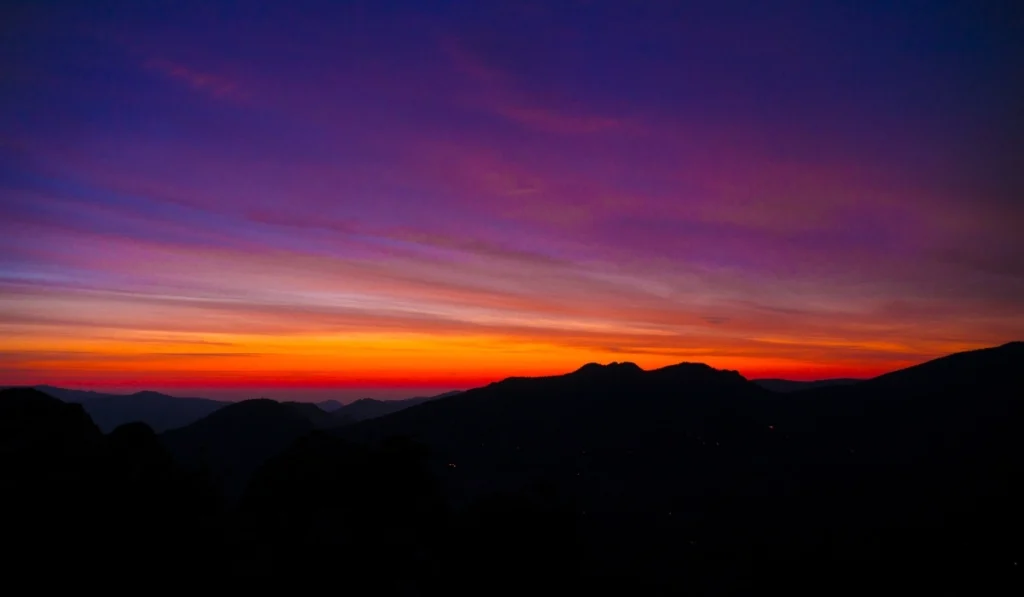
Why does the sky change color at sunset? The answer lies in how sunlight interacts with Earth’s atmosphere. As the sun descends toward the horizon, its light travels through more air, scattering blue wavelengths and allowing warm colors like orange, red, and pink to dominate the sky.
If you’ve ever paused to watch the sky transform from brilliant blue to warm orange and deep red as evening approaches, you’ve witnessed one of nature’s most reliable spectacles. But what’s actually happening up there?
The Science Behind Sunset Colors
How Sunlight Creates Different Colors
Here’s what most people don’t realize: sunlight looks white to our eyes, but it’s actually made up of all the colors of the rainbow traveling together. Each color has a different wavelength—think of it as a different size of wave rippling through space.
Blue and violet light have short, tight wavelengths. Red and orange light have long, stretched-out wavelengths.
This difference in size is what makes the whole sunset phenomenon possible.
Light Scattering in the Atmosphere
When sunlight enters Earth’s atmosphere, it doesn’t just pass through cleanly. It collides with gas molecules—mostly nitrogen and oxygen—and with tiny particles of dust, water vapor, and other substances floating in the air.
This collision causes something called scattering. The light bounces off these particles and spreads out in different directions.
But here’s the key: not all colors scatter the same way.
Shorter wavelengths (blue and violet) scatter much more easily than longer wavelengths (red and orange). In fact, blue light scatters about ten times more than red light does.
Why the Sky Appears Blue During Midday
During midday, when the sun is high overhead, sunlight takes a relatively short path through the atmosphere to reach your eyes.
As it travels, the blue light gets scattered in all directions—up, down, sideways—filling the entire sky. This is why when you look up on a clear day, you see blue everywhere, not just where the sun is.
The red and orange light? It mostly passes straight through without scattering much, which is why the sun itself appears white or yellowish during the day.
Why Does the Sky Change Color at Sunset?
Here’s where things get interesting. At sunset (and sunrise), the sun sits low on the horizon.
This means sunlight has to travel through a much thicker slice of atmosphere to reach you—sometimes nearly 40 times more air than when the sun is directly overhead.
The Long Atmospheric Path Filters Blue Light
As sunlight makes this long journey through extra atmosphere, almost all the blue light gets scattered away before it can reach your eyes. It bounces around so much that it essentially disappears from your line of sight.
What’s left? The colors that don’t scatter as easily—orange, red, and sometimes pink or purple.
These longer wavelengths make it through the atmospheric gauntlet and paint the sky in warm tones.
The more atmosphere the light travels through, the more blue gets filtered out, and the deeper the red and orange become.
What Makes Some Sunsets More Vibrant
If every sunset followed the same formula, they’d all look identical. But you’ve probably noticed that some evenings deliver spectacular shows while others are fairly subdued.
What makes the difference?
Atmospheric Particles Affect Color Intensity
The amount and type of particles suspended in the atmosphere play a huge role:
- Water vapor and humidity enhance scattering and create more vivid colors
- Dust and pollution particles intensify reds and oranges
- Volcanic eruptions inject particles into the upper atmosphere, creating unusually vibrant sunsets for months
- Smoke from wildfires produces deep red or orange skies
Cloud Position Creates Different Effects
Clouds act like screens that catch and reflect the colored light.
High, thin clouds often produce the most stunning displays because they’re positioned perfectly to catch the sun’s rays and reflect warm colors across the sky.
Low, thick clouds might block the effect entirely or create a more muted palette.
Geographic Location Influences Sky Color
Where you are on Earth matters too. Places closer to the equator might see different sunset characteristics than those at higher latitudes.
Coastal areas often have different atmospheric conditions than inland regions, affecting the intensity and duration of the color change.
Understanding Purple and Pink Sunset Hues
Sometimes you’ll notice purple or pink streaks mixed in with the orange and red.
This happens because some of the scattered blue light can mix with the red light that’s made it through the atmosphere. When these wavelengths combine in our perception, we see purples and magentas.
This effect is often most visible in the clouds and in the parts of the sky opposite the setting sun.
Sunrise Colors Follow the Same Physics
The same physics that creates colorful sunsets also works at sunrise—it’s just that fewer people are awake to witness it.
The mechanics are identical: long path through the atmosphere, blue light scattered away, warm colors dominating.
The main difference? Morning air often has different moisture and particle content than evening air, which can subtly alter the appearance.
Why Sky Color Changes Matter Beyond Beauty
Understanding why the sky changes color at sunset isn’t just about satisfying curiosity. It connects to broader concepts in physics and atmospheric science:
- Air quality monitoring: Unusual or particularly intense sunset colors can sometimes indicate air pollution levels
- Weather prediction: The appearance of the sky at sunset offers clues about upcoming weather patterns
- Climate science: Changes in atmospheric composition over time can subtly alter sunset characteristics
The Simple Explanation
The sky changes color at sunset because of how light interacts with Earth’s atmosphere.
Blue light, with its short wavelength, scatters easily and gets filtered out when sunlight travels through extra atmosphere at low angles. The red and orange light, with longer wavelengths, passes through more easily and reaches your eyes.
It’s a physics demonstration happening on a planetary scale, every single evening, driven by nothing more complicated than light bouncing off air molecules.
What Makes Each Sunset Unique
If you’ve ever wondered why some sunsets take your breath away, now you know: it’s the perfect combination of geometry, atmospheric composition, and the fundamental properties of light itself.
No two sunsets are identical because the atmosphere is constantly shifting—different moisture levels, different particles, different cloud formations.
The next time you catch yourself staring at a sunset, you’re not just watching the day end. You’re watching a light show produced by billions of molecular interactions, a visible reminder of the invisible ocean of air we live in.
And perhaps that makes it even more remarkable than it already appeared.