
A Night That Stopped Ancient Civilizations in Their Tracks.
Imagine you are a farmer in ancient Mesopotamia, 3,000 years ago. The night is clear. The full moon hangs bright and silver above the fields. Then, slowly, a shadow begins to cover her.
And then — the moon turns blood red.
To ancient observers, this was not astronomy. It was a warning. A message from the gods. An omen of war, plague, or the fall of kings.
Civilizations across the world — the Babylonians, the Inca, the Chinese — watched the blood moon with a mixture of awe and dread.
Today, we know exactly what causes it. And the real explanation? Just as fascinating as the myth.
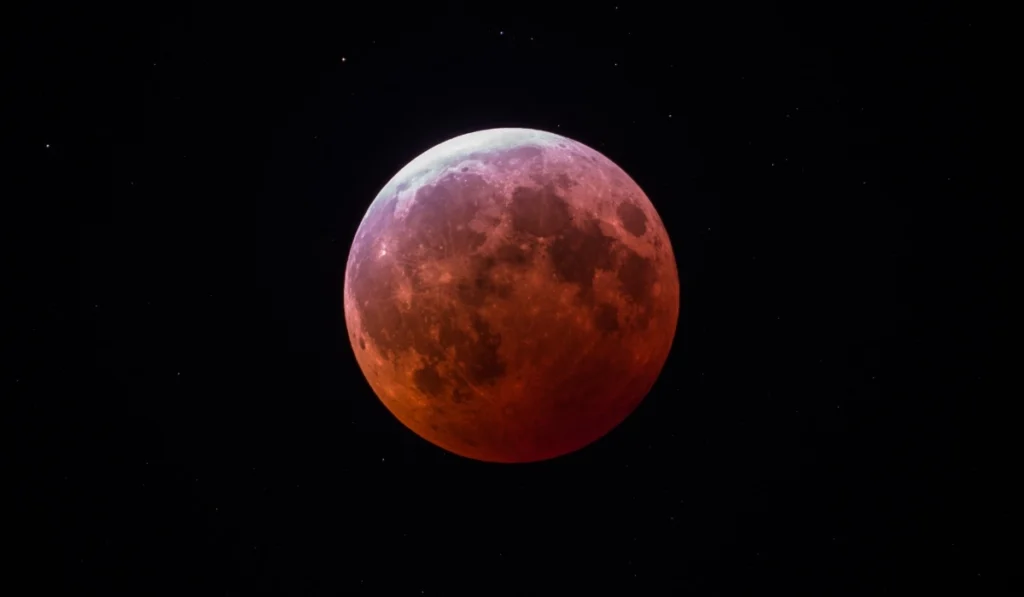
What Is a Blood Moon, Really?
A blood moon is not a separate astronomical object or a rare cosmic accident.
It is simply what a total lunar eclipse looks like from Earth — and the reason it turns red is one of the most elegant physics lessons our solar system has to offer.
To understand it, picture three things aligned in space: the Sun, the Earth, and the Moon.
During a total lunar eclipse, Earth moves directly between the Sun and the Moon, casting its shadow across the lunar surface. The Moon doesn’t disappear into complete darkness, though.
Instead, it glows red.
Why? Because of you. Because of every sunrise and sunset that has ever happened on Earth.
The Real Reason: Earth’s Atmosphere Creates the Blood Moon’s Color
When Earth blocks direct sunlight from reaching the Moon, it doesn’t block all light. A thin ring of our atmosphere bends sunlight around the edges of the planet — a process called refraction — and redirects some of that light toward the Moon.
But not all colors travel the same way through the atmosphere.
- Short wavelengths (blue, violet) scatter easily, bouncing off gas molecules and spreading in all directions — which is why the daytime sky is blue.
- Long wavelengths (red, orange) are more stubborn. They cut through with less interference, traveling farther without scattering.
So the only light that makes it around Earth and reaches the Moon during a total eclipse is the deep red and orange end of the spectrum.
The Moon becomes a screen onto which every single sunrise and sunset on Earth is projected simultaneously.
Think about that for a moment. When you look at a blood moon, you are seeing the collective glow of every horizon on Earth — all at once.
How Red Will the Blood Moon Be? It Depends
Not every blood moon looks the same.
The intensity of the red color varies depending on what is currently in Earth’s atmosphere. Scientists use the Danjon Scale to measure the brightness and color of lunar eclipses, ranging from 0 (very dark, nearly invisible) to 4 (bright orange-red with a blue edge).
Factors That Affect the Blood Moon’s Color:
- Volcanic eruptions: Ash and sulfur dioxide in the stratosphere block more sunlight, making the Moon appear darker. After the 1991 eruption of Mount Pinatubo, the December eclipse that year was unusually dark.
- Wildfires and dust storms: Large concentrations of smoke or dust in the atmosphere deepen the red tone.
- Seasonal humidity: A cleaner, drier atmosphere tends to produce more vivid, brighter red hues.
In other words, the blood moon is reflecting the state of Earth’s atmosphere back at us — an accidental mirror of our own planet’s condition.
Why Does a Blood Moon Only Happen During a Full Moon?
Lunar eclipses can only occur during a full moon — when the Moon sits on the opposite side of Earth from the Sun.
But not every full moon produces an eclipse.
The Moon’s orbit is tilted about 5 degrees relative to Earth’s orbital plane around the Sun. Most of the time, the Moon passes slightly above or below Earth’s shadow. True alignment is rare.
This is why total lunar eclipses — and, by extension, blood moons — happen only a few times per decade at any given location on Earth.
When the geometry is perfect, however, the result is one of the most accessible sky events in nature. Unlike solar eclipses, you need no special glasses or equipment.
You just need to look up.
The Blood Moon as a Reminder of How Small — and How Connected — We Are
There is something quietly humbling about a blood moon.
It asks nothing of you. It requires no telescope, no ticket, no preparation. It simply rises, red and silent, for anyone willing to look up.
And yet, in that single image — a crimson moon hanging in the dark — the entire machinery of the solar system is at work. The Sun, 150 million kilometers away, is pouring out light. Earth is casting its shadow with geometric precision. And our atmosphere, that razor-thin shell of air that makes all life possible, is bending and filtering that light into something that looks, to human eyes, like blood.
Every element of that scene depends on every other.
Remove the atmosphere, and the Moon simply goes dark. Move Earth a fraction off its orbital path, and the alignment never happens. Change the angle by a few degrees, and you get an ordinary full moon — beautiful, but ordinary.
The blood moon only exists because everything lines up, just right, at just the right moment.
Maybe that is the real reason ancient peoples stopped and stared. Not because they feared it — but because, somewhere beneath the superstition, they sensed what we now know to be true: that some moments in nature are not accidental. It’s the universe briefly revealing its mysteries.
And we, standing on a small planet, get to watch.
Blood Moon: Quick Reference Guide
| What it is | A total lunar eclipse as seen from Earth |
| Why it’s red | Refraction of red and orange light through Earth’s atmosphere |
| When it happens | Only during a full moon, with perfect Sun-Earth-Moon alignment |
| How often | A few times per decade per location |
| Equipment needed? | None — the naked eye is enough |
| What affects the color? | Volcanic ash, dust, atmospheric conditions |
The next time a blood moon appears, you won’t just see a red circle in the sky. You’ll see physics, atmosphere, geometry, and a little bit of Earth’s own history — all reflected back at you from 384,000 kilometers away.