
Why does thunder make a noise? It’s one of those questions that feels simple at first — but the real answer is genuinely surprising. Thunder isn’t just a random side effect of a storm. It’s the direct physical consequence of one of the most powerful electrical events in nature.
If you’ve ever flinched at a sudden crack, or found yourself counting seconds after a lightning flash, you’re not alone. That reaction is completely natural — and understanding what’s happening can make the whole experience a little less unsettling.
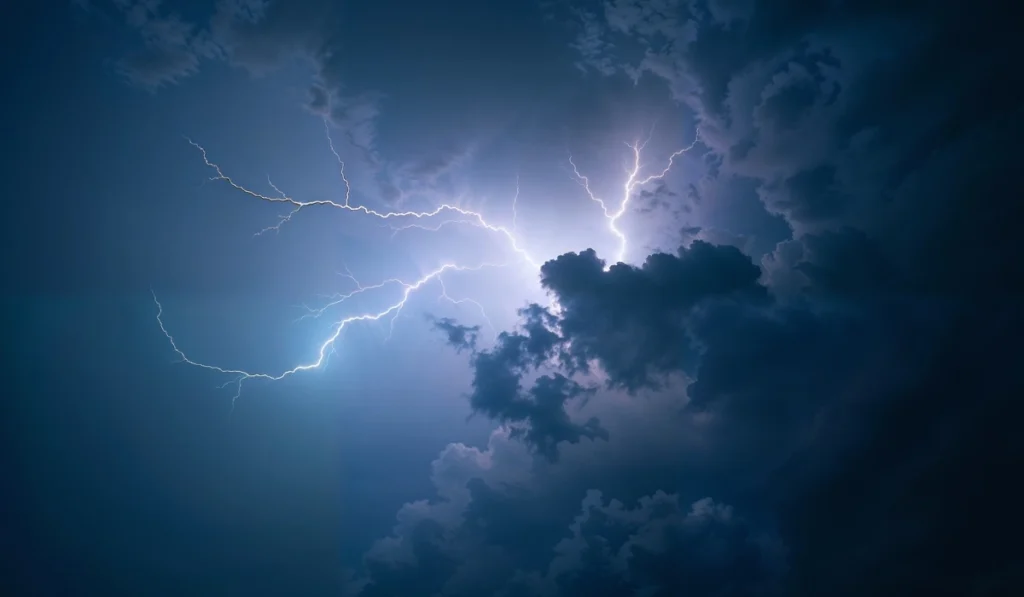
Why Does Thunder Make a Noise? The Science Explained
The answer starts with lightning. When a bolt strikes, it forces an enormous amount of electrical energy through a very narrow channel of air — sometimes no wider than your thumb.
That energy heats the air inside the channel to around 30,000 Kelvin — roughly five times hotter than the surface of the Sun.
At that temperature, the air doesn’t just get warm. It explodes outward — almost instantaneously — in every direction.
This violent expansion creates a shockwave. That shockwave is thunder. As it moves away from the lightning channel, it becomes a sound wave traveling through the air toward you.
Why Does Thunder Sound Different Each Time?
Thunder rarely sounds exactly the same twice — and there’s a clear reason for that.
A lightning bolt is not a straight line. It’s a long, irregular, branching channel that can stretch several kilometers through the sky. Every point along that channel generates its own shockwave at almost the same instant.
Since those points are at different distances from you, the waves arrive at your ears spread across time — not all at once. That’s what creates the different sounds you hear:
- Sharp crack or bang: The strike was close. The shockwave from a short channel hits you all at once.
- Long rolling rumble: The strike was far away, or the lightning channel was very long. Waves from different parts of it arrive seconds apart.
- Echo and reverb: Sound bouncing off clouds, hills, and buildings adds layers to the rumble, making it feel deeper and longer.
Why Do We See Lightning Before We Hear Thunder?
Light travels at about 300,000 kilometers per second. Sound moves through air at only about 343 meters per second — nearly a million times slower.
Both are produced at the exact same moment. But the light reaches your eyes almost instantly, while the sound takes time to travel.
This gap gives you a useful tool: every 3 seconds between the flash and the boom equals roughly 1 kilometer of distance (about 5 seconds per mile). It’s a simple and surprisingly reliable way to track how close a storm is.
Can Thunder Actually Hurt You?
Thunder itself is not dangerous. It is sound — and even at the intensity of a nearby strike, sound alone is not capable of causing physical harm.
Very close strikes can produce a pressure wave that feels jarring or disorienting, but the real risk in any thunderstorm is always the lightning — not the noise it makes.
If you can hear thunder, lightning is within roughly 16 kilometers (10 miles) of you. That’s close enough to take shelter. A practical rule: when thunder roars, go indoors.
Why Does Thunder Feel So Startling?
Understanding the physics of thunder doesn’t always make it feel less alarming — and that’s completely normal.
Our nervous system is wired to react fast to sudden loud sounds. A sharp crack of thunder triggers an automatic startle reflex — because for most of human history, unexpected loud noises meant danger.
If you or someone you know finds thunderstorms particularly distressing, that response is well recognized and entirely valid. Knowing the science is a first step — but the body sometimes takes a little longer to catch up with the mind.
Putting It All Together
The real answer is simple: lightning releases an extraordinary amount of energy in a fraction of a second, violently superheating the air around it. That air explodes outward as a shockwave — and that shockwave is what you hear.
The crack, the boom, the long rolling rumble — all of it is the same basic event expressing itself differently, shaped by distance, geometry, and the landscape around you.
Next time a storm rolls in and you hear that deep rumble, you’ll know exactly what you’re listening to: the acoustic record of one of nature’s most powerful electrical events. And if you count the seconds between the flash and the boom — now you know what that number means.