
Super El Niño 2026: What It Means for Global Weather
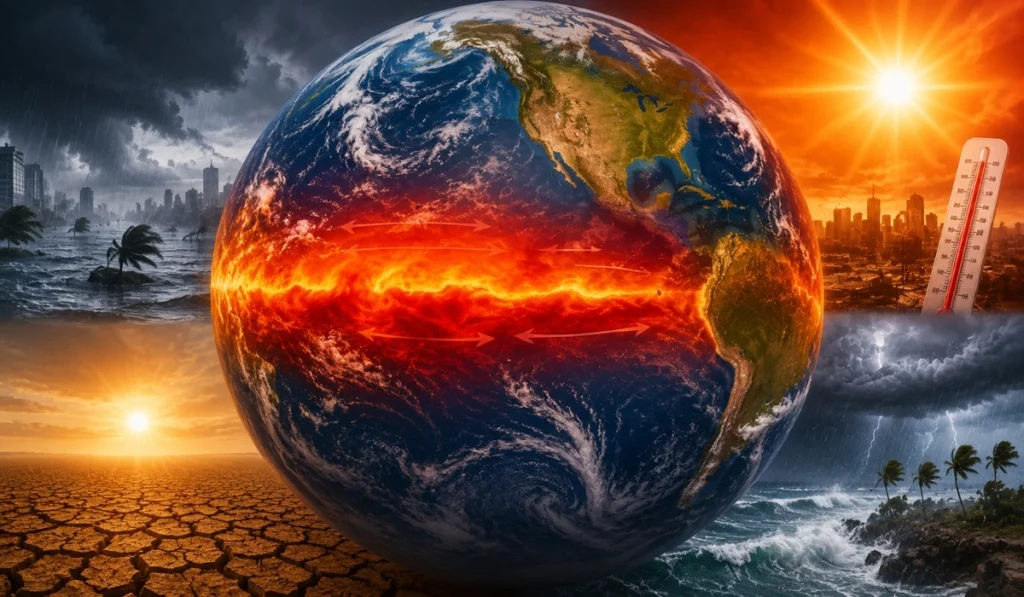
Imagine standing on a beach in Peru in late 2026, watching the ocean feel noticeably warmer than you remember. Fishermen nearby are pulling in unusual catches, and meteorologists thousands of miles away are watching satellite data with growing concern. Something is shifting beneath the surface of the Pacific Ocean, and it’s about to influence weather patterns across the globe. The Super El Niño 2026 is now officially underway, and it’s already shaping forecasts for the rest of this year and into 2027. But what does “Super” actually mean here, and why should it matter to you? What Makes an El Niño “Super”? Most explanations stop at “the ocean gets warmer.” But the real story is about scale, and scale changes everything. El Niño is declared when sea surface temperatures in the central and eastern tropical Pacific rise at least 0.5°C above average for several consecutive months, shifting trade winds in a pattern that typically lasts nine to twelve months and drives global weather. A “Super” El Niño involves anomalies of 2°C or more — a difference that represents an enormous amount of stored heat energy entering the atmosphere. This week, NOAA’s Climate Prediction Center placed the odds of this event becoming a “very strong” El Niño at 63%, with some models suggesting it could rank among the strongest ever recorded. The driving force is a massive pulse of warm water moving beneath the ocean’s surface, known as a Kelvin wave, now rising toward the surface and beginning to reorganize weather patterns starting in the tropics. How Pacific Ocean Temperatures Shape Weather Worldwide Here’s the part that tends to surprise people: a patch of warm water near the equator, thousands of miles from most population centers, can change whether your winter is wet or dry, whether hurricane season is busy or quiet, and even how likely wildfires become on the other side of the world. When that warm water rises, it shifts where rain clouds form over the Pacific. Air that normally rises over Indonesia and Australia instead rises further east, nudging the jet stream — the fast-moving river of air that steers storm systems across continents. In the United States, the Super El Niño 2026 tends to follow a fairly consistent pattern: None of these are guarantees. Every El Niño has its own personality, shaped by other ocean patterns happening at the same time. But the stronger the event, the more likely these effects appear. Regional Impacts: From Drought Relief to Flood Risk If you live somewhere stuck in drought, this part might sound like good news, with caveats. Take Colorado, which has spent recent years locked in a stubborn dry pattern. Climate experts note that El Niño tends to bring wetter-than-average conditions to southern Colorado, particularly in fall and spring. One state climatologist called this a “tentative dose of hope,” while cautioning that conditions may worsen before improving, since consecutive La Niña years have deepened the drought. Along California’s Central Coast, the contrast could be dramatic. Forecasters near Santa Barbara and San Luis Obispo are tracking the possibility of seasonal rainfall reaching 40 to 50 inches instead of the typical 14 inches, with the heaviest impacts expected in winter 2026 into 2027. “More rain” isn’t automatically a simple win, though. Regions accustomed to dry conditions can struggle to absorb sudden heavy rainfall, leading to flooding and landslides — a reminder that climate patterns redistribute extremes rather than simply removing them. Why This El Niño Could Push Global Temperatures Even Higher Beyond rearranging rainfall, El Niño tends to nudge global average temperatures upward for a year or two, layering on top of the long-term warming trend already underway. Scientists note this added boost makes it increasingly likely that 2027 could surpass 2024 as the planet’s warmest year on record. This happens because El Niño releases heat stored in the deep ocean back into the atmosphere, briefly amplifying warming from other causes. El Niño itself is a temporary, natural cycle that has occurred for thousands of years and will eventually give way to its cooler counterpart, La Niña. But when a strong natural warming cycle stacks on an already-warming baseline, the combined effect can feel unprecedented, even though the cycle itself is nothing new. What Happens Next Right now, the world is watching a slow-motion handoff. The ocean has shifted from a cooling La Niña pattern into a warming El Niño pattern, and the atmosphere is just beginning to respond. Models currently put the odds of El Niño persisting through the core of winter at around 96%, meaning the real question isn’t “if” anymore, it’s “how strong.” For most people, the takeaway isn’t to panic over any single forecast. It’s to pay attention as the picture sharpens over the coming months, especially if you live in a region known to be sensitive to these patterns, such as coastal California, the southern U.S., the Amazon basin, or Southeast Asia. What’s most fascinating is how something happening in a remote stretch of ocean can ripple outward to shape whether someone on the other side of the planet needs an umbrella, or whether a wildfire season turns dangerous. The next time the news mentions the Super El Niño 2026, you’ll know it’s not just weather jargon, it’s the echo of something much larger, still unfolding beneath the waves. This article is for general informational purposes and reflects forecasts and expert commentary available as of June 2026. Climate predictions carry uncertainty and can change as new data becomes available.
Solar Cycle Behavior Change: Why Is the Sun Different Now?
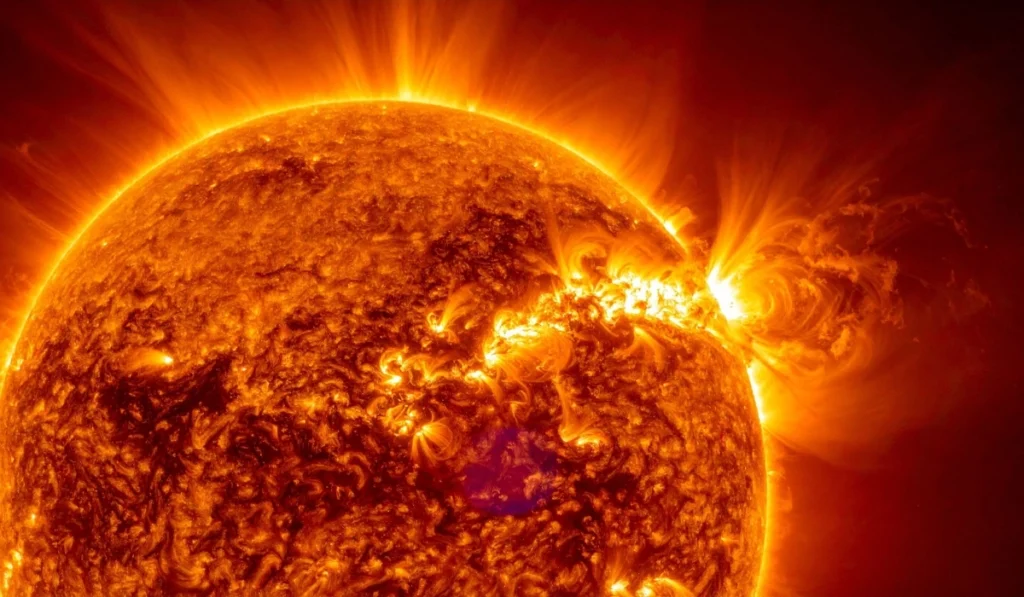
You step outside on a summer morning, squint at that blazing yellow disk in the sky, and think: at least the Sun is reliable. Everything else changes — the weather, the news, your Wi-Fi signal. But the Sun? The Sun just burns. Except it doesn’t. Not in the way we assumed. Scientists who have spent nearly four decades literally listening to the interior of our star have found something that challenges one of the most fundamental tools we use to understand it. The Sun’s internal activity right now looks nothing like what the surface is showing us. And that gap — between what we see and what’s actually happening inside — might be telling us something important about where our star is headed. What We Thought We Knew About the Sun’s Cycles The Sun doesn’t burn at a constant rate. It goes through cycles of roughly 11 years, during which its magnetic activity rises and falls. At the peak of each cycle, the Sun is peppered with dark patches called sunspots — regions where intense magnetic fields disrupt the surface. At the low point, the surface looks comparatively calm. For centuries, counting sunspots has been astronomy’s most reliable way to measure how active the Sun is: We are currently living through Solar Cycle 25. By the sunspot count, this cycle was supposed to be relatively tame — notably weaker than the intense cycles of the late 1980s and early 1990s. Many scientists considered the Sun to be going through a quieter phase. But the surface, it turns out, doesn’t tell the whole story. How Scientists “Listen” to the Sun’s Interior To understand what happens deep inside the Sun — regions no telescope can ever directly observe — researchers use a technique called helioseismology. Think of it as a solar ultrasound. The Sun is constantly vibrating. Pressure waves, similar in nature to sound waves, travel through its interior and bounce between different layers. As these waves pass through regions with varying temperatures, densities, and magnetic conditions, their frequencies shift. By measuring those shifts from Earth, scientists can infer what’s happening thousands of kilometers beneath the solar surface — the same way geologists use seismic waves to map the Earth’s core without drilling through it. A team led by Professor William Chaplin at the University of Birmingham has been collecting this data since 1987 through the Birmingham Solar-Oscillations Network (BiSON) — six telescopes spread across the globe that together provide an almost uninterrupted view of the Sun’s oscillations. That’s nearly 40 years of solar data covering four complete solar cycles. What the Sound Waves Actually Found The researchers divided the Sun’s pressure waves into three frequency bands, each sensitive to different depths: When the team compared wave behavior across Solar Cycle 25 against earlier cycles — especially the strong Cycle 22 from the late 1980s — they found a striking mismatch. The high-frequency waves in Cycle 25 were reacting far more strongly than expected for a so-called weak cycle. Internally, the Sun was behaving as powerfully as it had during Cycle 22, one of the most active periods on record. Meanwhile, mid-frequency waves had shown progressively less sensitivity to surface activity across the past three cycles. Something had been shifting gradually and quietly since around 2005. The conclusion is clear: Solar Cycle 25’s internal activity is much stronger than its sunspot count suggests. The Sun’s magnetic behavior hasn’t weakened — it has simply migrated closer to the surface, making it nearly invisible to the tools we’ve relied on for centuries. Why Is the Sun’s Behavior Changing? This is where science reaches one of its honest, thrilling limits: we can describe the pattern, but we don’t yet fully understand what’s driving it. What the data shows is a gradual migration of magnetic activity toward the solar surface across successive cycles. In the past, the structural changes associated with the Sun’s 11-year rhythm occurred at greater depths. Over the last three cycles, those changes have progressively moved upward — now concentrated within just a few hundred kilometers of the surface. Researcher Sarbani Basu of Yale University, co-author of the study published in the Monthly Notices of the Royal Astronomical Society in May 2026, notes that this solar cycle behavior change cannot be explained by a simple weakening of the Sun’s magnetic fields. A reduction in field strength would affect the size of the observed signals — but not the sensitivity of different wave frequencies to those signals. That shift in sensitivity points to something more structural: the Sun appears to be reorganizing where and how it stores its magnetic energy internally. Whether this represents a temporary fluctuation, a multi-decade transition, or the beginning of a fundamentally new pattern is something only future cycles will answer. Why This Matters for Life on Earth The Sun’s activity cycle isn’t just an astronomical curiosity. It has real consequences for everyday life. Solar flares and coronal mass ejections — bursts of charged particles launched into space during periods of high activity — can: Space weather forecasting currently relies heavily on surface observations like sunspot counts. If the Sun’s internal activity is consistently stronger than the surface suggests, our early-warning systems may be systematically underestimating risk. Better helioseismic monitoring — listening more carefully to what the Sun says beneath its surface — could dramatically improve the accuracy of those forecasts. The Question This Discovery Leaves Open There’s something quietly striking about this finding. Not because it’s dangerous, but because it reminds us how much of the Sun we still haven’t seen. We’ve been watching sunspots for over 400 years. We’ve launched satellites to observe solar flares in real time. We’ve sent probes within kissing distance of the solar corona. And yet the most significant solar cycle behavior change of recent decades — a gradual reorganization of the Sun’s internal magnetic structure — only became visible after 40 years of patiently listening to vibrations we can’t even hear. The Sun isn’t hiding. It’s just more layered than its surface
Blood Moon: Why Does the Moon Turn Red During a Lunar Eclipse?
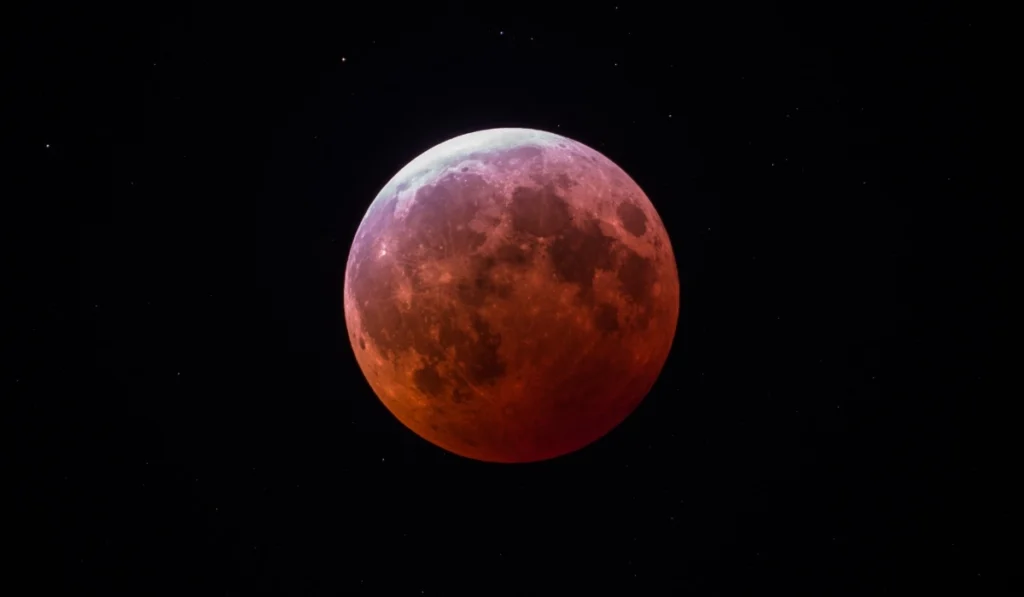
A Night That Stopped Ancient Civilizations in Their Tracks. Imagine you are a farmer in ancient Mesopotamia, 3,000 years ago. The night is clear. The full moon hangs bright and silver above the fields. Then, slowly, a shadow begins to cover her. And then — the moon turns blood red. To ancient observers, this was not astronomy. It was a warning. A message from the gods. An omen of war, plague, or the fall of kings. Civilizations across the world — the Babylonians, the Inca, the Chinese — watched the blood moon with a mixture of awe and dread. Today, we know exactly what causes it. And the real explanation? Just as fascinating as the myth. What Is a Blood Moon, Really? A blood moon is not a separate astronomical object or a rare cosmic accident. It is simply what a total lunar eclipse looks like from Earth — and the reason it turns red is one of the most elegant physics lessons our solar system has to offer. To understand it, picture three things aligned in space: the Sun, the Earth, and the Moon. During a total lunar eclipse, Earth moves directly between the Sun and the Moon, casting its shadow across the lunar surface. The Moon doesn’t disappear into complete darkness, though. Instead, it glows red. Why? Because of you. Because of every sunrise and sunset that has ever happened on Earth. The Real Reason: Earth’s Atmosphere Creates the Blood Moon’s Color When Earth blocks direct sunlight from reaching the Moon, it doesn’t block all light. A thin ring of our atmosphere bends sunlight around the edges of the planet — a process called refraction — and redirects some of that light toward the Moon. But not all colors travel the same way through the atmosphere. So the only light that makes it around Earth and reaches the Moon during a total eclipse is the deep red and orange end of the spectrum. The Moon becomes a screen onto which every single sunrise and sunset on Earth is projected simultaneously. Think about that for a moment. When you look at a blood moon, you are seeing the collective glow of every horizon on Earth — all at once. How Red Will the Blood Moon Be? It Depends Not every blood moon looks the same. The intensity of the red color varies depending on what is currently in Earth’s atmosphere. Scientists use the Danjon Scale to measure the brightness and color of lunar eclipses, ranging from 0 (very dark, nearly invisible) to 4 (bright orange-red with a blue edge). Factors That Affect the Blood Moon’s Color: In other words, the blood moon is reflecting the state of Earth’s atmosphere back at us — an accidental mirror of our own planet’s condition. Why Does a Blood Moon Only Happen During a Full Moon? Lunar eclipses can only occur during a full moon — when the Moon sits on the opposite side of Earth from the Sun. But not every full moon produces an eclipse. The Moon’s orbit is tilted about 5 degrees relative to Earth’s orbital plane around the Sun. Most of the time, the Moon passes slightly above or below Earth’s shadow. True alignment is rare. This is why total lunar eclipses — and, by extension, blood moons — happen only a few times per decade at any given location on Earth. When the geometry is perfect, however, the result is one of the most accessible sky events in nature. Unlike solar eclipses, you need no special glasses or equipment. You just need to look up. The Blood Moon as a Reminder of How Small — and How Connected — We Are There is something quietly humbling about a blood moon. It asks nothing of you. It requires no telescope, no ticket, no preparation. It simply rises, red and silent, for anyone willing to look up. And yet, in that single image — a crimson moon hanging in the dark — the entire machinery of the solar system is at work. The Sun, 150 million kilometers away, is pouring out light. Earth is casting its shadow with geometric precision. And our atmosphere, that razor-thin shell of air that makes all life possible, is bending and filtering that light into something that looks, to human eyes, like blood. Every element of that scene depends on every other. Remove the atmosphere, and the Moon simply goes dark. Move Earth a fraction off its orbital path, and the alignment never happens. Change the angle by a few degrees, and you get an ordinary full moon — beautiful, but ordinary. The blood moon only exists because everything lines up, just right, at just the right moment. Maybe that is the real reason ancient peoples stopped and stared. Not because they feared it — but because, somewhere beneath the superstition, they sensed what we now know to be true: that some moments in nature are not accidental. It’s the universe briefly revealing its mysteries. And we, standing on a small planet, get to watch. Blood Moon: Quick Reference Guide What it is A total lunar eclipse as seen from Earth Why it’s red Refraction of red and orange light through Earth’s atmosphere When it happens Only during a full moon, with perfect Sun-Earth-Moon alignment How often A few times per decade per location Equipment needed? None — the naked eye is enough What affects the color? Volcanic ash, dust, atmospheric conditions The next time a blood moon appears, you won’t just see a red circle in the sky. You’ll see physics, atmosphere, geometry, and a little bit of Earth’s own history — all reflected back at you from 384,000 kilometers away.
Why Does Thunder Make a Noise?
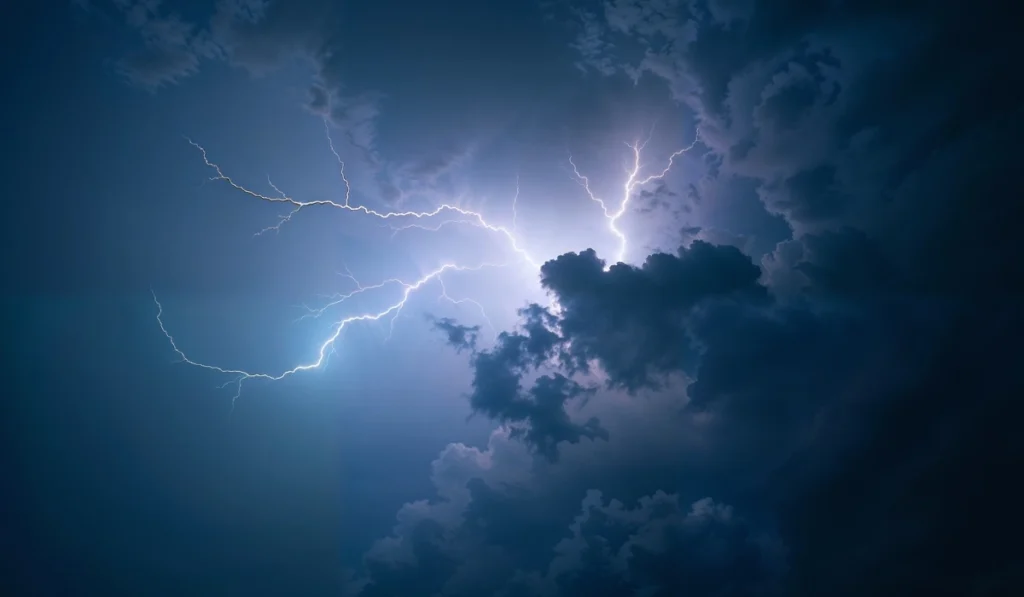
Why does thunder make a noise? It’s one of those questions that feels simple at first — but the real answer is genuinely surprising. Thunder isn’t just a random side effect of a storm. It’s the direct physical consequence of one of the most powerful electrical events in nature. If you’ve ever flinched at a sudden crack, or found yourself counting seconds after a lightning flash, you’re not alone. That reaction is completely natural — and understanding what’s happening can make the whole experience a little less unsettling. Why Does Thunder Make a Noise? The Science Explained The answer starts with lightning. When a bolt strikes, it forces an enormous amount of electrical energy through a very narrow channel of air — sometimes no wider than your thumb. That energy heats the air inside the channel to around 30,000 Kelvin — roughly five times hotter than the surface of the Sun. At that temperature, the air doesn’t just get warm. It explodes outward — almost instantaneously — in every direction. This violent expansion creates a shockwave. That shockwave is thunder. As it moves away from the lightning channel, it becomes a sound wave traveling through the air toward you. Why Does Thunder Sound Different Each Time? Thunder rarely sounds exactly the same twice — and there’s a clear reason for that. A lightning bolt is not a straight line. It’s a long, irregular, branching channel that can stretch several kilometers through the sky. Every point along that channel generates its own shockwave at almost the same instant. Since those points are at different distances from you, the waves arrive at your ears spread across time — not all at once. That’s what creates the different sounds you hear: Why Do We See Lightning Before We Hear Thunder? Light travels at about 300,000 kilometers per second. Sound moves through air at only about 343 meters per second — nearly a million times slower. Both are produced at the exact same moment. But the light reaches your eyes almost instantly, while the sound takes time to travel. This gap gives you a useful tool: every 3 seconds between the flash and the boom equals roughly 1 kilometer of distance (about 5 seconds per mile). It’s a simple and surprisingly reliable way to track how close a storm is. Can Thunder Actually Hurt You? Thunder itself is not dangerous. It is sound — and even at the intensity of a nearby strike, sound alone is not capable of causing physical harm. Very close strikes can produce a pressure wave that feels jarring or disorienting, but the real risk in any thunderstorm is always the lightning — not the noise it makes. If you can hear thunder, lightning is within roughly 16 kilometers (10 miles) of you. That’s close enough to take shelter. A practical rule: when thunder roars, go indoors. Why Does Thunder Feel So Startling? Understanding the physics of thunder doesn’t always make it feel less alarming — and that’s completely normal. Our nervous system is wired to react fast to sudden loud sounds. A sharp crack of thunder triggers an automatic startle reflex — because for most of human history, unexpected loud noises meant danger. If you or someone you know finds thunderstorms particularly distressing, that response is well recognized and entirely valid. Knowing the science is a first step — but the body sometimes takes a little longer to catch up with the mind. Putting It All Together The real answer is simple: lightning releases an extraordinary amount of energy in a fraction of a second, violently superheating the air around it. That air explodes outward as a shockwave — and that shockwave is what you hear. The crack, the boom, the long rolling rumble — all of it is the same basic event expressing itself differently, shaped by distance, geometry, and the landscape around you. Next time a storm rolls in and you hear that deep rumble, you’ll know exactly what you’re listening to: the acoustic record of one of nature’s most powerful electrical events. And if you count the seconds between the flash and the boom — now you know what that number means.
Why Does the Sky Change Color at Sunset?
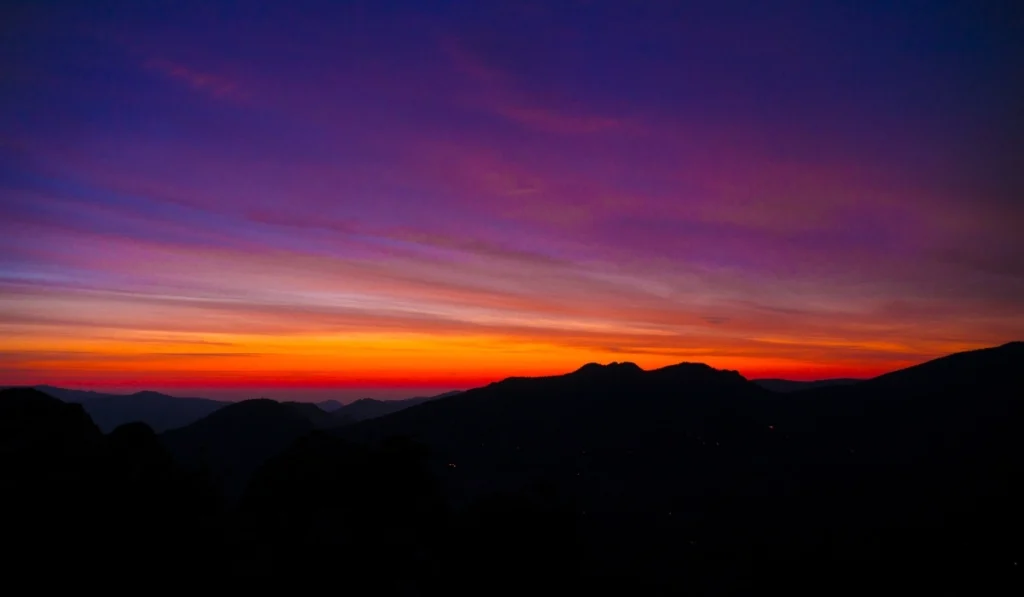
Why does the sky change color at sunset? The answer lies in how sunlight interacts with Earth’s atmosphere. As the sun descends toward the horizon, its light travels through more air, scattering blue wavelengths and allowing warm colors like orange, red, and pink to dominate the sky. If you’ve ever paused to watch the sky transform from brilliant blue to warm orange and deep red as evening approaches, you’ve witnessed one of nature’s most reliable spectacles. But what’s actually happening up there? The Science Behind Sunset Colors How Sunlight Creates Different Colors Here’s what most people don’t realize: sunlight looks white to our eyes, but it’s actually made up of all the colors of the rainbow traveling together. Each color has a different wavelength—think of it as a different size of wave rippling through space. Blue and violet light have short, tight wavelengths. Red and orange light have long, stretched-out wavelengths. This difference in size is what makes the whole sunset phenomenon possible. Light Scattering in the Atmosphere When sunlight enters Earth’s atmosphere, it doesn’t just pass through cleanly. It collides with gas molecules—mostly nitrogen and oxygen—and with tiny particles of dust, water vapor, and other substances floating in the air. This collision causes something called scattering. The light bounces off these particles and spreads out in different directions. But here’s the key: not all colors scatter the same way. Shorter wavelengths (blue and violet) scatter much more easily than longer wavelengths (red and orange). In fact, blue light scatters about ten times more than red light does. Why the Sky Appears Blue During Midday During midday, when the sun is high overhead, sunlight takes a relatively short path through the atmosphere to reach your eyes. As it travels, the blue light gets scattered in all directions—up, down, sideways—filling the entire sky. This is why when you look up on a clear day, you see blue everywhere, not just where the sun is. The red and orange light? It mostly passes straight through without scattering much, which is why the sun itself appears white or yellowish during the day. Why Does the Sky Change Color at Sunset? Here’s where things get interesting. At sunset (and sunrise), the sun sits low on the horizon. This means sunlight has to travel through a much thicker slice of atmosphere to reach you—sometimes nearly 40 times more air than when the sun is directly overhead. The Long Atmospheric Path Filters Blue Light As sunlight makes this long journey through extra atmosphere, almost all the blue light gets scattered away before it can reach your eyes. It bounces around so much that it essentially disappears from your line of sight. What’s left? The colors that don’t scatter as easily—orange, red, and sometimes pink or purple. These longer wavelengths make it through the atmospheric gauntlet and paint the sky in warm tones. The more atmosphere the light travels through, the more blue gets filtered out, and the deeper the red and orange become. What Makes Some Sunsets More Vibrant If every sunset followed the same formula, they’d all look identical. But you’ve probably noticed that some evenings deliver spectacular shows while others are fairly subdued. What makes the difference? Atmospheric Particles Affect Color Intensity The amount and type of particles suspended in the atmosphere play a huge role: Cloud Position Creates Different Effects Clouds act like screens that catch and reflect the colored light. High, thin clouds often produce the most stunning displays because they’re positioned perfectly to catch the sun’s rays and reflect warm colors across the sky. Low, thick clouds might block the effect entirely or create a more muted palette. Geographic Location Influences Sky Color Where you are on Earth matters too. Places closer to the equator might see different sunset characteristics than those at higher latitudes. Coastal areas often have different atmospheric conditions than inland regions, affecting the intensity and duration of the color change. Understanding Purple and Pink Sunset Hues Sometimes you’ll notice purple or pink streaks mixed in with the orange and red. This happens because some of the scattered blue light can mix with the red light that’s made it through the atmosphere. When these wavelengths combine in our perception, we see purples and magentas. This effect is often most visible in the clouds and in the parts of the sky opposite the setting sun. Sunrise Colors Follow the Same Physics The same physics that creates colorful sunsets also works at sunrise—it’s just that fewer people are awake to witness it. The mechanics are identical: long path through the atmosphere, blue light scattered away, warm colors dominating. The main difference? Morning air often has different moisture and particle content than evening air, which can subtly alter the appearance. Why Sky Color Changes Matter Beyond Beauty Understanding why the sky changes color at sunset isn’t just about satisfying curiosity. It connects to broader concepts in physics and atmospheric science: The Simple Explanation The sky changes color at sunset because of how light interacts with Earth’s atmosphere. Blue light, with its short wavelength, scatters easily and gets filtered out when sunlight travels through extra atmosphere at low angles. The red and orange light, with longer wavelengths, passes through more easily and reaches your eyes. It’s a physics demonstration happening on a planetary scale, every single evening, driven by nothing more complicated than light bouncing off air molecules. What Makes Each Sunset Unique If you’ve ever wondered why some sunsets take your breath away, now you know: it’s the perfect combination of geometry, atmospheric composition, and the fundamental properties of light itself. No two sunsets are identical because the atmosphere is constantly shifting—different moisture levels, different particles, different cloud formations. The next time you catch yourself staring at a sunset, you’re not just watching the day end. You’re watching a light show produced by billions of molecular interactions, a visible reminder of the invisible ocean of air we live in. And perhaps that makes it even more remarkable than it already