
You step outside on a summer morning, squint at that blazing yellow disk in the sky, and think: at least the Sun is reliable. Everything else changes — the weather, the news, your Wi-Fi signal. But the Sun? The Sun just burns.
Except it doesn’t. Not in the way we assumed.
Scientists who have spent nearly four decades literally listening to the interior of our star have found something that challenges one of the most fundamental tools we use to understand it. The Sun’s internal activity right now looks nothing like what the surface is showing us.
And that gap — between what we see and what’s actually happening inside — might be telling us something important about where our star is headed.
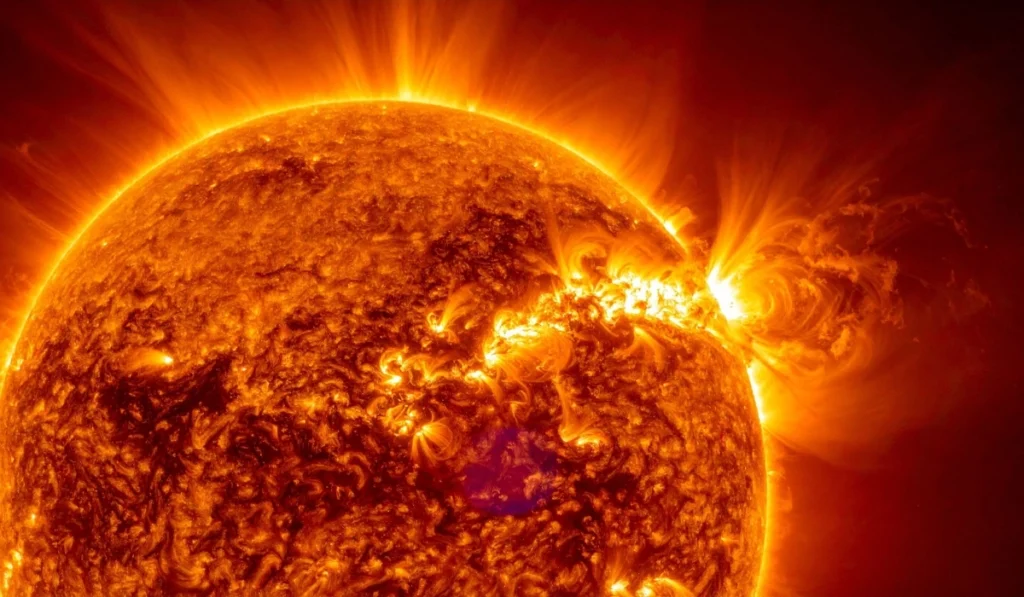
What We Thought We Knew About the Sun’s Cycles
The Sun doesn’t burn at a constant rate. It goes through cycles of roughly 11 years, during which its magnetic activity rises and falls.
At the peak of each cycle, the Sun is peppered with dark patches called sunspots — regions where intense magnetic fields disrupt the surface. At the low point, the surface looks comparatively calm.
For centuries, counting sunspots has been astronomy’s most reliable way to measure how active the Sun is:
- More sunspots = more active Sun
- More active Sun = more solar flares and radiation
- More flares = more risk to satellites, GPS, and power grids on Earth
We are currently living through Solar Cycle 25. By the sunspot count, this cycle was supposed to be relatively tame — notably weaker than the intense cycles of the late 1980s and early 1990s. Many scientists considered the Sun to be going through a quieter phase.
But the surface, it turns out, doesn’t tell the whole story.
How Scientists “Listen” to the Sun’s Interior
To understand what happens deep inside the Sun — regions no telescope can ever directly observe — researchers use a technique called helioseismology. Think of it as a solar ultrasound.
The Sun is constantly vibrating. Pressure waves, similar in nature to sound waves, travel through its interior and bounce between different layers. As these waves pass through regions with varying temperatures, densities, and magnetic conditions, their frequencies shift.
By measuring those shifts from Earth, scientists can infer what’s happening thousands of kilometers beneath the solar surface — the same way geologists use seismic waves to map the Earth’s core without drilling through it.
A team led by Professor William Chaplin at the University of Birmingham has been collecting this data since 1987 through the Birmingham Solar-Oscillations Network (BiSON) — six telescopes spread across the globe that together provide an almost uninterrupted view of the Sun’s oscillations. That’s nearly 40 years of solar data covering four complete solar cycles.
What the Sound Waves Actually Found
The researchers divided the Sun’s pressure waves into three frequency bands, each sensitive to different depths:
- Low-frequency waves — reach deep into the interior, below 3,000 km from the surface
- Mid-frequency waves — probe intermediate layers
- High-frequency waves — most sensitive to a thin shell roughly 1,000 km beneath the surface
When the team compared wave behavior across Solar Cycle 25 against earlier cycles — especially the strong Cycle 22 from the late 1980s — they found a striking mismatch.
The high-frequency waves in Cycle 25 were reacting far more strongly than expected for a so-called weak cycle. Internally, the Sun was behaving as powerfully as it had during Cycle 22, one of the most active periods on record.
Meanwhile, mid-frequency waves had shown progressively less sensitivity to surface activity across the past three cycles. Something had been shifting gradually and quietly since around 2005.
The conclusion is clear: Solar Cycle 25’s internal activity is much stronger than its sunspot count suggests. The Sun’s magnetic behavior hasn’t weakened — it has simply migrated closer to the surface, making it nearly invisible to the tools we’ve relied on for centuries.
Why Is the Sun’s Behavior Changing?
This is where science reaches one of its honest, thrilling limits: we can describe the pattern, but we don’t yet fully understand what’s driving it.
What the data shows is a gradual migration of magnetic activity toward the solar surface across successive cycles. In the past, the structural changes associated with the Sun’s 11-year rhythm occurred at greater depths. Over the last three cycles, those changes have progressively moved upward — now concentrated within just a few hundred kilometers of the surface.
Researcher Sarbani Basu of Yale University, co-author of the study published in the Monthly Notices of the Royal Astronomical Society in May 2026, notes that this solar cycle behavior change cannot be explained by a simple weakening of the Sun’s magnetic fields.
A reduction in field strength would affect the size of the observed signals — but not the sensitivity of different wave frequencies to those signals. That shift in sensitivity points to something more structural: the Sun appears to be reorganizing where and how it stores its magnetic energy internally.
Whether this represents a temporary fluctuation, a multi-decade transition, or the beginning of a fundamentally new pattern is something only future cycles will answer.
Why This Matters for Life on Earth
The Sun’s activity cycle isn’t just an astronomical curiosity. It has real consequences for everyday life.
Solar flares and coronal mass ejections — bursts of charged particles launched into space during periods of high activity — can:
- Disrupt satellite communications and GPS signals
- Interfere with power grids and cause widespread blackouts
- Affect airline routes passing over polar regions
- Damage spacecraft and pose radiation risks to astronauts
Space weather forecasting currently relies heavily on surface observations like sunspot counts. If the Sun’s internal activity is consistently stronger than the surface suggests, our early-warning systems may be systematically underestimating risk.
Better helioseismic monitoring — listening more carefully to what the Sun says beneath its surface — could dramatically improve the accuracy of those forecasts.
The Question This Discovery Leaves Open
There’s something quietly striking about this finding. Not because it’s dangerous, but because it reminds us how much of the Sun we still haven’t seen.
We’ve been watching sunspots for over 400 years. We’ve launched satellites to observe solar flares in real time. We’ve sent probes within kissing distance of the solar corona. And yet the most significant solar cycle behavior change of recent decades — a gradual reorganization of the Sun’s internal magnetic structure — only became visible after 40 years of patiently listening to vibrations we can’t even hear.
The Sun isn’t hiding. It’s just more layered than its surface implies.
And that raises a question worth holding onto: if the star that makes all life on Earth possible is quietly reorganizing itself in ways our best instruments almost missed — what else might we be misreading by only looking at the surface of things?